Understanding prepositional phrases may not seem crucial for casual texting, but knowing what they are can make your writing—and even your chat messages—way clearer and more effective.
Whether you’re composing emails, messaging friends, or crafting content for social media, prepositional phrase meaning help convey relationships between people, places, and things smoothly.
In this article, we’ll break down what a prepositional phrase meaning really is, show you how to use it correctly, provide relatable examples, and even highlight common mistakes people make. By the end, you’ll be able to spot them, use them confidently, and maybe even impress your friends with your linguistic finesse.
What Does “Prepositional Phrase” Mean? (Definition & Origin)
A prepositional phrase is a group of words that begins with a preposition and ends with a noun, pronoun, or a noun phrase, called the object of the preposition. In simple terms, it tells you where, when, or how something is happening.
Example:
- The cat on the roof is sleeping.
Here, “on the roof” is a prepositional phrase describing where the cat is.
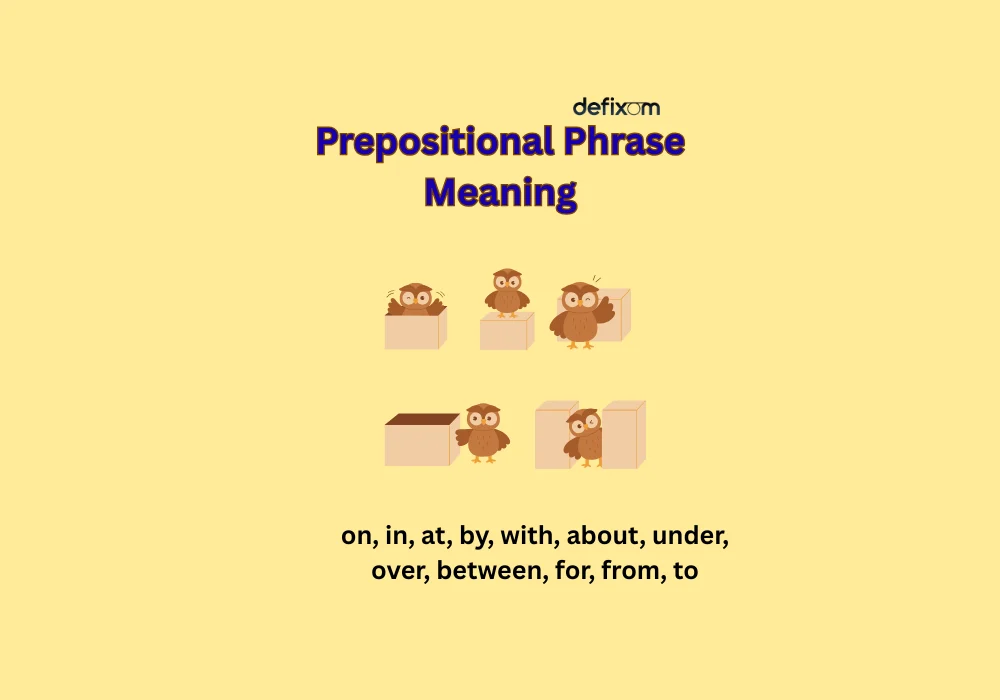
Common Prepositions:
Prepositions are words like:
- on, in, at, by, with, about, under, over, between, for, from, to
Origin:
Prepositional phrases come from traditional grammar but have remained relevant in modern communication, from texting to professional emails. Even in casual chat, they help structure sentences and clarify meaning.
How to Use “Prepositional Phrase” in Texts or Chat
While formal grammar sounds “old-school,” prepositional phrases pop up everywhere—even in short texts. They help make your messages clearer, friendlier, or more descriptive.
1. Indicating Location or Direction
- Meet me at the park later?
- She left her bag under the table.
2. Expressing Time
- I’ll see you after lunch.
- He’s been working since morning.
3. Adding Detail or Emotion
- I’m nervous about the interview.
- He’s happy with his new phone.
Pro Tip: Even in texts, a well-placed prepositional phrase can avoid confusion. Instead of “I’ll come,” you can say “I’ll come after class”—instantly more precise.
Examples of Prepositional Phrases in Conversations
Seeing prepositional phrases in real-world chats makes them easier to understand and use. Here are some relatable examples:
Casual Texting:
- Can we hang out at your place tonight?
- I’ll meet you in front of Starbucks.
Social Media Comments:
- Loved the photo from your trip!
- Feeling blessed with my friends.
Professional or Email Context:
- Please review the document before the meeting.
- The report on market trends is attached.
Notice how the phrases naturally fit the sentence and provide essential context.
Common Mistakes or Misunderstandings
Even experienced writers and texters can slip up with prepositional phrases. Here are frequent mistakes:
1. Ending Sentences with a Preposition (Optional in Modern English)
- ❌ Where are you at?
- ✅ Where are you? or Where are you at the moment?
2. Confusing Preposition Choice
- ❌ I’m interested on this topic.
- ✅ I’m interested in this topic.
3. Dangling Prepositional Phrases
- ❌ Running late, the bus was missed by Sarah.
- ✅ Running late, Sarah missed the bus.
Fun Tip: In casual texting, native speakers sometimes bend these rules—but clarity is key.
Related Slangs or Abbreviations
You might be wondering how this old-school grammar term connects to modern texting or chat culture. It actually pops up indirectly:
- IRL (In Real Life): Functions like a prepositional phrase. “I’ll see you IRL” = “I’ll see you in real life.”
- BTW (By the way): Prepositional phrases are often abbreviated in casual online messaging.
- OMG, FYI, TFW: While not strictly grammar, these abbreviations sometimes replace phrases that could include prepositional elements.
Using prepositional phrases correctly gives your messages the same clarity as these popular shortcuts—but with full words.
Why Prepositional Phrases Matter in 2026 Texting & Writing
In 2026, communication is fast, digital, and often emoji-heavy—but grammar still matters. Prepositional phrases:
- Make messages clearer, reducing miscommunication.
- Add professionalism to emails, LinkedIn posts, and formal chats.
- Help non-native speakers understand relationships between actions, objects, and contexts.
- Improve readability in long-form content, blogs, and social media captions.
Even a short text like:
- Can you send the files from yesterday?
becomes instantly clearer with a prepositional phrase.
Conclusion
Understanding the prepositional phrase meaning isn’t just about school grammar—it’s about effective communication in texting, chatting, and writing in 2026. By knowing how to identify and use them:
- Your sentences become clearer and more precise.
- You avoid common mistakes that confuse readers or friends.
- You can mix traditional grammar with modern slang effortlessly.
Next time you text, post, or write, look out for phrases like “on the desk,” “after work,” or “with friends”—and notice how much smoother your message reads.

I am a curious writer at Defixom who loves breaking down words, meanings, and ideas into simple, easy-to-understand explanations. My goal is to help readers quickly find clear answers without confusion, using clean language and real human insight.